
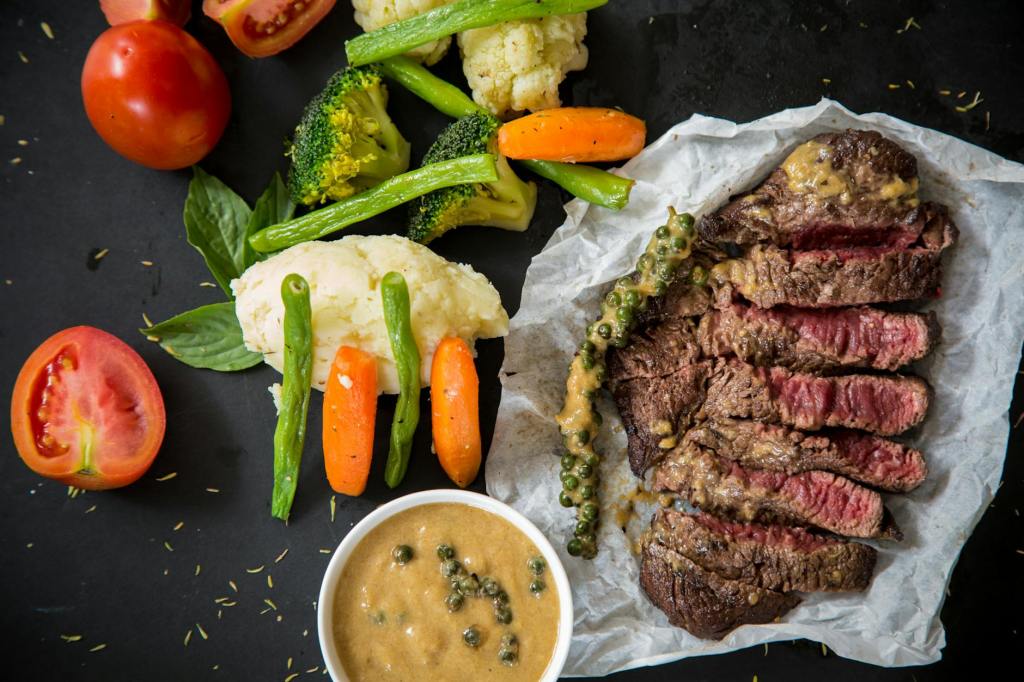
You cannot outwork a bad diet. You can walk, run, lift, and exercise your butt off, until you have nothing left. But you will be spinning your tires if your nutrition isn’t dialled in. You’ve heard of the saying, “abs are made in the kitchen”. It’s pretty accurate. It’s really tough to develop a great physique, feel good and stay healthy when your diet is garbage. The truth is that you need both fitness and nutrition to develop a great physique. They work very well together. The winning combination is a solid workout plan paired with a nutrition plan that sets you up to succeed. It does not have to be perfect, just mostly right. Training for most people is the easy part. Nutrition can be feel a little more complicated. Let me simplify it for you with some basic rules.
Rule 1 – Your diet needs to be sustainable.
A diet that restricts specific foods for the wrong reason is not sustainable. The only diet that will provide lasting results is one that you can consistently stick to. Contrary to what you see on social media, there is no magic diet that will cause you to build muscle, lose fat and be healthy. Diets that call for you to cut out meat, cut out vegetables, fast for days on end, cut out alcohol, cut out pizza, cut out gluten, cut out dairy, cut out anything, are fad diets that should be avoided at all cost. Obviously don’t eat anything that you are allergic to or intolerant to. But any diet that tells you that in 90 days you will be completely shredded if you just cut out specific foods that you love to eat, are not worth your time. If you are willing to cut out bread for the rest of your life, then yes follow the paleo diet. If you are willing to cut out meat for the rest of your life, follow a vegan diet. If you plan on never drinking a drop of alcohol again, then follow a diet that 100% restricts alcohol. If you plan on only eating meat for the rest of your life, then follow the carnivore diet.
But if you want to eat healthy but also sometimes eat the things that you want, then these diets are worthless. They are temporary diets that will cause fat loss, but you will almost certainly put on all that weight and more as soon as you don’t 100% follow these restrictive diets. Why not follow a diet where you eat mostly healthy foods but also treat yourself from time to time?
When you follow a diet that restricts a certain food or lots of foods, all your brain can think of is eating those foods. Eventually, you will give in to your cravings whether its one day or one week or one year. And the weight will pile back on. So don’t fully restrict any food unless you actually see yourself doing it long term or if your body does not react well to that food. You need to follow a diet that is sustainable long term. Experts believe that 80-95% of people who lose weight gain it all back at some point. Regardless of what the number is, yo-yo dieting is a problem. We work so hard to lose the weight. We need to figure out a way to sustain the “diet” long term. Let’s talk about the word “diet”. When I refer to the word diet, I literally just mean the food that you eat. I’m not referring to fat loss or muscle gain or anything in particular. What you eat is your diet. So let’s discuss why the body loses fat and muscle or gains fat and muscle.
Rule 2 – Weight loss or weight gain comes down to calories in vs calories out.
The reason why people lose weight during the fad diets mentioned above are not because pizza is bad or sugar is bad or meat is bad or carbs are bad. It is because they are in a caloric deficit. This means that they are eating less calories than they are burning during the day. It’s really this simple. Being in a caloric deficit is the only way you can lose body fat. Period. There are no magic “fat burning foods”. There is no magic diet. It comes down to the simple fact that if you want to lose weight, you need to eat less calories than you are burning. It also works the other way. In order to gain weight, you need to eat more calories than you are burning. So how do we do that?
You need to figure out what your Total Daily Energy Expenditure (TDEE) is. There are many calculators online but I will recommend the TDEE calculator on legionathletics.com. Punch in your numbers to get a rough estimate on how many calories you need to eat each day.
Once you figure out how many calories you need to eat to either lose weight or gain weight (depending on your goal), you need to start tracking what you eat. I highly recommend that you download myfitnesspal (or any other food tracking app) for free on your phone and track what you eat for a minimum of a few weeks. Even a week of tracking will show you just how much (or little) you are eating on a daily basis. Maybe you don’t plan on tracking forever because that’s not sustainable for you. That’s completely fine. But you need to figure out a baseline of what your diet consists of currently and what you need to do to move the needle on the scale. TDEE calculators will tell you exactly how many calories you need to eat depending on your goal. Stick to that number for a few weeks and see what kind of progress you are making. You will learn a ton about nutrition just by tracking for a few weeks.
Rule 3 – Calories are made up of 3 macronutrients – Protein, Carbohydrates and Fat.
When you eat a food, it either has 1 to 3 of the three macronutrients. Protein and Carbohydrates have 4 calories per gram. Fats have 9 calories per gram. Whether your goal is to lose fat or gain muscle, I recommend keeping your protein intake between .7g to 1g of protein per pound of body weight. If you weigh 180 lbs, that is 126-180 grams of protein per day. Most people who have not been focusing on their nutrition severely under consume protein. Protein builds muscle, helps satiety (feeling full) and helps the muscle recover from exercise. It helps with fat loss by keeping you full and preventing loss of muscle. It helps with muscle gain by repairing muscles after they have been broken down in the gym. It is the number 1 macronutrient you need to focus on. Everything revolves around protein. You need to strive to consistently hit your protein number. This is one change that you can make immediately that will significantly affect your physique and reduce your hunger levels. Increase your protein.
So now let’s focus on carbs and fats. Some of these fad diets will lead you to believe that either one of them are bad. It’s not true. Fill the rest of your daily calories with some combination of carbs and fats. Try to keep your fat intake between 15-20% of your total calories, which is about .3g per pound of body weight.
Here are some simple rules for tracking.
• Calculate your TDEE
• Download a food tracking app such as myfitnesspal
• Hit your calorie number on a daily basis.
• Protein is king of the three macronutrients. Aim for .7g to 1g per pound of body weight per day.
• Fill in the rest of your calories with any combination of carbs and fat. Try not to go below 15-20% of your daily calories from fat for general health.
• Aim to hit 1 gram of fibre per 10 grams of carbohydrates.
• Track on a consistent basis and try to hit your numbers.
Rule 4: Eat mostly whole foods that do not come in package.
While we aren’t cutting out any particular foods, most of your diet should come from whole foods that are not processed. In general, this is a good rule of thumb. Not only will the foods be healthier and filled with micronutrients, they will be more filling. In general, you will be able to eat more of them. For example, compare 150 calories of strawberries compared to 150 calories of potato chips. Your plate will be overflowing with strawberries but you will only have about 15 chips. Which do you think will keep you fuller for longer? In general, the less ingredients on the food label, the better the food is for you. Focus on whole natural foods and your diet will be very easy to follow.
Rule 5: Eat the foods you enjoy.
Regardless of whether the food meets the criteria of Rule 4, you should find the foods that you like to eat and work them into your diet. Tracking your diet is a bit like a budget, but think of it in a positive way. It gives you permission to eat the foods that you like, rather than feeling terrible about “slipping up”. Many people that don’t track will eat healthy most of the day and then eat a small bowl of chips. Then they feel bad about themselves and finish the whole bag and call the day a failure. It did not have to be a failure. If you eat healthy for most of the day, know that you will likely have enough calories to treat yourself for supper or at nighttime.
Tracking doesn’t need to feel restrictive or bad. It actually allows you to eat foods that aren’t necessarily typical “fat loss” foods. We all love these foods. If I told myself that I wasn’t allowed to eat pizza, I would crave nothing else but pizza. And I will feel bad when I inevitably eat pizza. Some people think that tracking what you eat is an “eating disorder” or is “unhealthy”. For me, it’s actually the opposite. It allows me to maintain a positive relationship with food because nothing is off limits.
There are literally an endless variety of fruits, vegetables, grains, proteins, carbs and fats. Start figuring out which ones you enjoy and eat those things to make up your diet. If you start a diet plan that calls for 2 cups of kale and kale makes you want to throw up, then that diet plan is useless. Substitute a vegetable that you actually enjoy. If you don’t like canned tuna, stop shovelling it down. Eat what you like. Experiment with different flavours and spices. Eat the foods that you enjoy and your diet will never feel restrictive. You just need to track it to ensure you are hitting your goals.
Just because you have decided to improve your health and physique by working out and eating better does not mean that you need to stop living your life. You can still eat with your family. You can still go out to restaurants. You can still enjoy a glass of wine with your spouse. You can still eat the foods that you love. You just need to factor in these foods when you are planning your day. If you know you’re going out to eat at a restaurant for supper, you know that you’ll need to take it easy and eat smaller portions for the rest of the day. If you know you’re going out for drinks tonight, then save some calories to be able to enjoy it. Stop with the all or nothing approach. It doesn’t work in life, fitness and definitely does not work here either.
Rule 6: There are three nutrition goals. Bulking. Cutting. Maintaining. Focus on one at a time.
When it comes to tracking your nutrition, you can have three goals but should do one at a time. They can happen simultaneously, especially if you are new to weightlifting. However, it is important that you have one goal at a time. Many people, including myself, spend many years in a perpetual state of bouncing back and forth between short stints of bulking and cutting. This will kill your progress. Focus on one goal at a time.
Bulking involves eating in a caloric surplus. You are eating more calories than you are burning. If your main goal is to put on muscle but you are okay with putting on some body fat, you will want to be in a bulking phase. You’ll want to be eating 10-20% more calories than you are burning while bulking. You should not overeat when in a bulking phase. Being in a bulk does not give you permission to eat whatever you want. You just need to be eating a little bit more than you are burning each day to ensure you are putting on muscle and size.
Cutting involves eating in a caloric deficit. You are eating less calories than you are burning. If you do not like the way your body looks at its current body fat percentage, you should likely be in a cutting phase. You’ll want to be eating 20-25% less calories than you are burning each day.
Maintenance phase involves eating around the same amount of calories that you burn every day. If you get to a point where you really like the way you look and you don’t want to gain muscle or lose body fat, a maintenance phase is right for you. Perhaps you bulked all winter and cut in time for summer. A maintenance phase might get you through the summer until you are ready to bulk again.
Rule 7: It’s okay not to follow your diet 100% of the time.
We are human. We live stressful lives. Things come up unexpectedly. We don’t always get it right. There are many days that I overeat. What I don’t do is turn one day into a weekend of overeating. Just because I don’t track my calories one day or if I go over my calories does not mean that I am a bad person or that I need to feel guilty about it. I just get back on the horse the next day. It’s that simple.
Know that you won’t get it right every day. As long as you get it right the majority of the time, you are moving the needle in the right direction. You are being intentional with your nutrition which is more than 99% of the population can say. Don’t turn one bad meal into a week of bad eating. If you miss a day, just start a new streak the next day. Get back to the mission. Life is meant to be lived. Tracking is not meant to make you feel bad about your food choices or to restrict you. It is a way to be more intentional with your food choices. It’s a way to learn about what you are actually putting inside your body. Tracking actually gives you permission to enjoy the foods you love, guilt free, but within reason. If you get it right even 80% of the time, you will be in the best shape of your life.
Rule 8: Limit liquid calories as much as possible. Drink water.
I learned at a very young age when I started tracking my diet that I needed to cut out the liquid calories. They don’t keep you full and it is very easy to over consume liquid calories. A can of pop has 30-50 grams of sugar in it but it provides no nutritional value and does not help control hunger or satiety. Especially when trying to lose fat, avoid liquid calories if possible. It is so difficult to sustain a cut when most of your calories are coming from drinks. It does not leave you many calories to actually consume and nourish your body. If you only have 200 grams of carbs and you drink 50-100 grams per day of sugary drinks, that is 25-50% of your daily carb intake. Fit them into your diet every once in a while but try to replace them with water or diet soda.
It is very important to drink water and stay hydrated. Not only does it keep you healthy in many ways, but it also keeps you feeling full. Aim to drink 3 to 4 liters of water per day (.75-1 gallon).
If you enjoyed this article, please check out my book The Daily Mission. Part 2 of the book is jam packed with health, fitness and nutrition knowledge that I have acquired over decades of research. I’ve read the books and the articles. I’ve listened to thousands of hours of podcasts. I have also lived it. There is no quick fix and no magic pill. It’s consistently focusing on the little things over time. It’s our obligation to ourselves and our family to be fit and healthy. You can do this.


 Ascend
Leave a reply to Exactly What You Need To Do To Lose Weight – The Daily Mission Cancel reply